




Published April 4, 2026 · 8 min read
Family Outdoor Safety Guide: Sun Protection for Kids and Adults on Year-Round Outdoor Trips
Family outdoor trips — whether summer beach vacations, winter ski weeks, or shoulder-season camping — share a common sun safety challenge: protecting multiple people with different skin types, different levels of sun awareness, and varying tolerance for applying sunscreen. Getting this right as a family matters more than most parents realize. UV damage in childhood accumulates into adult skin cancer risk in ways that are now well-established in the dermatological literature. This guide gives you a practical, realistic family sun protection system that works year-round.
Why Kids Need More Protection, Not Less
Children's skin is genuinely more vulnerable to UV damage than adult skin, for reasons that go beyond the fact that children spend more time outdoors.
Children's Skin Is More UV-Sensitive
Children have thinner, more transparent skin than adults — UV rays penetrate to deeper tissue layers more easily. The melanin system that provides some natural UV protection in adults is less developed in children. Infants under 6 months have skin so sensitive that the American Academy of Pediatrics recommends avoiding direct sun exposure entirely, relying on shade, clothing, and hats rather than sunscreen for this age group.
Childhood Sunburns Are Disproportionately Damaging
Research consistently shows that severe sunburns in childhood and adolescence — particularly blistering burns — significantly elevate lifetime melanoma risk. One blistering sunburn before age 18 is associated with a roughly doubled lifetime melanoma risk. The UV damage accumulated in childhood contributes to adult skin cancer risk decades later. Protecting children's skin is a genuine long-term health investment, not a precautionary overcorrection.
Children Are Outdoors Longer and at Higher-Risk Times
Children at the beach, resort, park, or campsite are typically outdoors during peak UV hours — they don't take midday breaks, they forget to reapply, and they resist sunscreen application. The practical challenge of keeping children sun-protected requires different strategies than protecting adults.
Sun Protection by Family Member
Infants (Under 6 Months)
The safest UV protection for very young infants is physical: shade, stroller canopies, UV-protective clothing, and infant sun hats. Keep infants in full shade during outdoor activities. When clothing is the primary protection, ensure it provides meaningful coverage — loosely woven fabrics offer little UV blocking. If unavoidable sun exposure occurs, a small amount of SPF 30+ mineral sunscreen on exposed areas is acceptable, but it's a last resort for this age group rather than a primary strategy.
Toddlers and Young Children (1–10 Years)
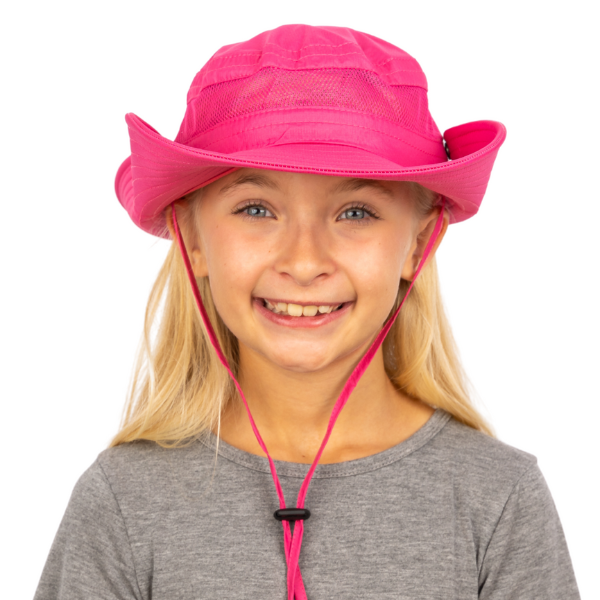
The hat is your most powerful tool. A wide-brim hat that stays on reliably is the highest-impact single protection item for young children — it provides continuous protection to the face, ears, and neck without requiring reapplication. A chin strap is non-negotiable; any children's hat without one will be off in minutes. Apply SPF 50+ broad-spectrum sunscreen to all exposed skin 15–20 minutes before outdoor time, and reapply every 80–90 minutes, after swimming, or any time the child towels off.
Tweens and Teens (11–17 Years)
Teens are often the worst protected family members because they resist sun protection measures more actively. A few things that actually work: keep sunscreen in an accessible, easy-to-apply format (sticks and sprays have better teen compliance than lotions); frame UPF clothing as performance activewear rather than medical gear; and give them agency over their own SunUp app — knowing their actual UV index and burn time in real time is more motivating than being told to reapply.
Adults
Adults typically set the standard for the whole family. When parents model consistent sun protection — applying it routinely, wearing a hat, seeking shade during peak hours — children absorb that behavior as normal. The reverse is also true. The family sun protection system works best when adults lead it by example, not just instruction.
Year-Round Protection: What Changes by Season
| Season | UV Risk Level | Key Threat | What to Do |
|---|---|---|---|
| Summer | Very High (UV 8–11) | Direct UV peak hours | Full protection, seek shade 10 AM–4 PM |
| Spring / Fall | Moderate–High (UV 4–7) | Underestimated UV on "nice" days | Hat + SPF still required; don't skip |
| Winter (ski) | High (UV 6–10 at altitude) | Snow reflection + elevation | Balaclava, goggles, SPF on exposed face |
| Winter (low altitude) | Low–Moderate (UV 1–3) | Accumulated exposure from driving, errands | Daily SPF on face still valuable |
The Family Sun Protection Kit
The kit that actually travels and gets used is different from the ideal kit. Simplify where possible.
- Wide-brim UPF 50+ hats for every family member: Including kids. A hat that fits well and has a chin strap gets worn; one that doesn't fit gets left in the bag. GearTop makes UPF 50+ hats for adults and kids designed to stay on during active outdoor time.
- SPF 50+ mineral sunscreen — one large tube, multiple travel sizes: One full-size stays in the beach bag or cooler; travel sizes go in every pack and jacket pocket. If it's not immediately accessible, reapplication doesn't happen.
- UPF 50+ cover-up shirts for everyone: Lightweight and packable. Worn during rest breaks and while eating, they handle the midday UV coverage without requiring sunscreen reapplication on covered areas.
- UV400 sunglasses for all ages: Including children. Pediatric eye UV protection is consistently overlooked. Kids' eyes are more UV-sensitive than adult eyes — the lens transmits more UV to the retina.
- Portable shade: A beach canopy, umbrella, or collapsible shelter gives the family a UV-safe retreat during peak sun hours without forcing everyone inside.
Family outdoor time is some of the most valuable time you'll spend together. Protecting everyone's skin during those trips — through all seasons and all conditions — is how you make sure those experiences don't come with long-term health consequences that show up decades later. The habit established in family outdoor trips is often the one that follows children into adult life. Make that habit a good one.
Related Reading
- 17 Summer Safety Tips for Sun Protection
- UV Protection Hat Buyer's Guide
- UV Sensitivity by Skin Type: The Fitzpatrick Scale






Leave a comment (all fields required)