





By Greg Kowalczyk · GearTOP · LinkedIn
Quick answer: The best children's sun hat has UPF 50+ fabric (blocks about 98% of UV), a brim of at least 3 inches all the way around, and a chin strap with a breakaway clasp that stays on a kid who is actively trying to take it off. Every GearTOP children's sun hat is UPF 50+ and priced $20.99–$21.99, or $35.98 for a 2-pack.
Here's the version that actually matters to parents: for babies under 6 months, the hat isn't accessorizing. The American Academy of Pediatrics says to keep babies younger than 6 months out of direct sunlight and to use sunscreen only on small areas like the face when shade and protective clothing aren't available (HealthyChildren.org, AAP). So for the youngest kids, the hat is the sun protection — not a backup to it.
A child's skin burns faster than yours at the same UV index. And the damage adds up: the Skin Cancer Foundation reports that having 5 or more sunburns doubles your risk for melanoma, and that frequent severe sunburns in early childhood especially raise it (Skin Cancer Foundation). The kids' hat isn't a fashion item. It's the cheapest skin-cancer prevention you'll ever buy.
In this guide I'll cover what to look for, how to match a hat to your kid's age, and the GearTOP children's sun hat line — plus how a UV app fits into the whole family's protection.
The Five-Point Checklist for a Children's Sun Hat
A children's sun hat needs five things, and a hat missing any one of them is a compromise.
- UPF 50+ — blocks 98% of UV (49 of every 50 rays). This is the rating you want.
- 3" brim, all around — covers the face, ears, and back of the neck. That's the AAP standard.
- Chin strap with a safety release — keeps it on a toddler without strangulation risk.
- Adjustable fit — elastic headband or drawstring so it actually fits now and next season.
- Under 6 months: shade first — hat + shade + clothing are the main defense; sunscreen only on small exposed areas.
Why Kids Need a Sun Hat More Than Adults Do
Kids need a sun hat more than adults because their skin burns faster and childhood sunburns count against them for decades.
The same UV index that gives you a faint flush can produce a real burn on a toddler. Then there's the cumulative part: the damage doesn't reset when the redness fades.
What does this mean practically? Two things:
- Check the UV index before you leave the house. The World Health Organization says sun protection measures should be used when the UV index reaches 3 or above (WHO). How fast a kid actually burns depends on skin type, age, location, and reflection off sand or water — there's no single number that fits every child. The SunUp app shows the live UV index and a personal burn-time estimate for your location — check it before playground trips the same way you check the weather.
- The hat does the work sunscreen skips. Sunscreen misses hairlines and gets wiped off. A UPF 50+ hat covers the scalp, ears, and neck — the spots that burn worst on a kid — and it never wears off or needs reapplying.
What to Look For in a Children's Sun Hat
Look for UPF 50+ fabric, a 3-inch all-around brim, a breakaway chin strap, an adjustable fit, and coverage that reaches the ears and neck.
1. UPF 50+ fabric
UPF (Ultraviolet Protection Factor) is the fabric equivalent of SPF. According to the Skin Cancer Foundation, a UPF 50 fabric blocks 98 percent of the sun's rays and lets 1/50th through (Skin Cancer Foundation). UPF 30 lets through 1/30th, about 3.3%, blocking 96.7% (Cancer Council Australia). That sounds close, but it means a UPF 30 hat passes about two-thirds more UV than a UPF 50+ hat. For a kid's skin, take the 50+.
One caveat worth knowing: UPF is measured on dry, unstretched fabric. The Skin Cancer Foundation notes that clothing which gets stretched or wet loses some of its protective ability — a soaked cotton hat or a hat stretched tight over a too-big head protects less. Quick-dry synthetics like nylon and polyester are the better pick for splash pads and beaches.
2. A 3-inch brim, all the way around
The AAP's guidance is specific here: a hat with an all-around 3-inch brim to shield the face, ears, and back of the neck. A baseball cap fails this test — it leaves the ears and neck wide open. For a kid bent over a sandbox or a splash pad, the back of the neck is exactly where the sun lands.
3. A chin strap (with a safety release)
Kids pull hats off. It's not a negotiation, it's a reflex. A chin strap is what keeps the hat on past the first five minutes.
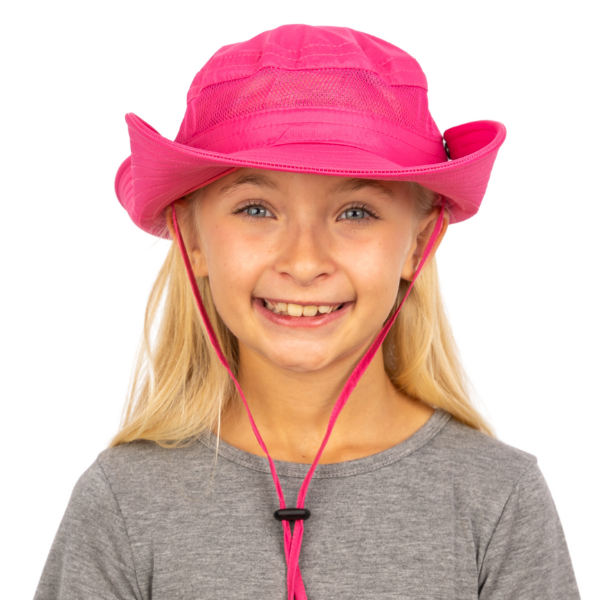
Two safety notes that most roundups skip: keep the strap short and snug, and look for a breakaway / quick-release clasp. Long ties on a baby are a strangulation hazard — a breakaway strap gives you the retention without the risk. The GearTOP Ariel and Voyager kids' hats both use breakaway clasps. Always supervise a baby in any hat with ties.
4. A fit that adjusts
Kids' heads grow in bursts. A hat with an internal drawstring or elastic headband fits now and next summer, instead of becoming too tight by August. This is the difference between a hat you replace every season and one you get two years out of.
5. Coverage for ears and neck
The best kids' hats extend protection down, not just out — either a deeper crown, a neck flap, or a foldable back panel. If your kid spends all day in a stroller or carrier, a neck flap covers the spot the brim misses when they're reclined.
Matching the Hat to Your Kid's Age
The right children's sun hat changes with age: infants need soft full coverage, toddlers need a strap they can't defeat, and older kids need durability and a spare.
Infants (0–2): They can't tell you they're burning, and they're often reclined (stroller, carrier, lying on a blanket). Soft, foldable, full-coverage is the priority. The GearTOP Discoverer Kids children's sun hat (with neck flaps) and the foldable Ariel (fish design, water-resistant) are built for this — lightweight, no stiff brim digging in when they lie down.
Toddlers (1–4): This is the "taking the hat off" age. Chin strap + adjustable fit become non-negotiable. The GearTOP Navigator Kids (single or the 2-pack) and the Voyager Kids series are made for this stage.
Kids (4–8): They're running, climbing, and losing things. You'll want the same UPF 50+ plus durability and a spare. The Navigator Kids 2-Pack (two hats, $35.98) is the practical move here — one for school or camp, one for the bag that never gets returned to you. For longer hair that a bucket hat crushes, the Navigator Ponytail Kids has a built-in ponytail opening.
GearTOP Kids Lineup at a Glance
Every GearTOP children's sun hat in the lineup is rated UPF 50+, and single hats run $20.99 to $21.99.
| Hat | Price | Best for | Standout feature |
|---|---|---|---|
| Navigator Kids (single) | $20.99 | Toddlers, everyday | UPF 50+, adjustable, chin strap |
| Navigator Kids 2-Pack | $35.98 | Siblings, spares, daycare | Two hats, ~$18 each |
| Discoverer Kids | $20.99 | Infants, stroller days | Neck flaps, full coverage |
| Ariel (fish design) | $21.99 | Babies & toddlers | Foldable, breakaway clasps |
| Voyager Kids | $20.99 | Toddlers, outdoor play | 3-inch brim, breakaway clasp |
| Traveler Kids | $20.99 | Family trips | Packable, adjustable |
| Navigator Ponytail Kids | $20.99 | Kids with long hair | Ponytail opening, UPF 50+ |
On price: $20.99 for one, or effectively $18 a hat in the 2-pack. Same UPF 50+ rating either way, plus a spare for when one inevitably ends up at a playground.
How the Hat Fits Into a Full Sun Protection Plan
A children's sun hat is necessary but not sufficient — it works best as one layer of a five-part sun plan.
- Shade during peak hours — the AAP says UV rays are strongest between 10 a.m. and 4 p.m.
- UPF hat + UPF clothing — the hat is this guide; add a UPF rash guard or shirt for water play.
- Sunscreen — broad-spectrum, reapplied every 2 hours and after swimming or sweating (AAP). Under 6 months, only on small exposed areas.
- Sunglasses — kids' eyes need UV protection too.
- Know the UV before you go — SunUp by GearTOP has an 8-day UV forecast for planning the week, and family mode lets you check UV conditions where your kids are — at camp, at the grandparents' — even when you're not there.
The hat is the only one of these a kid can't wipe off, sweat off, or throw back at you.
Frequently Asked Questions
What kind of sun hat do pediatricians recommend for kids?
Pediatricians recommend a hat with a brim of at least 3 inches all the way around, which the American Academy of Pediatrics says shields the face, ears, and back of the neck. Pick UPF 50+ fabric, which blocks about 98% of UV. For babies under 6 months, the AAP puts shade, clothing, and a hat ahead of sunscreen.
Do babies under 6 months need sunscreen?
Mostly no. The American Academy of Pediatrics says to keep babies younger than 6 months out of direct sunlight, using shade, protective clothing, and a wide-brim hat. Sunscreen is for small areas of the body, such as the face, only when shade and protective clothing aren't available. At this age, the sun hat is the primary defense.
What UPF rating is best for a children's sun hat?
UPF 50+ is the best rating for a children's sun hat. It blocks about 98% of UV, while UPF 30 blocks about 96.7%. That gap looks small, but a UPF 30 hat lets roughly two-thirds more UV reach the skin than a UPF 50+ hat. For a child's skin, which burns faster than an adult's, choose UPF 50+.
How do I keep a toddler from pulling off their sun hat?
Three things help: a chin strap (ideally with a breakaway clasp for safety), an adjustable fit that isn't uncomfortable, and modeling — wear your own hat. If it's a struggle, let them choose the color. A hat they picked is a hat they keep, and a snug strap means a toddler can't simply flick it off mid-play.
Is a bucket hat or a wide-brim hat better for a child?
It depends on the activity. A bucket hat gives 360° coverage in a compact shape and stays on well. A wide-brim hat shades the face and neck more aggressively but is easier to shake off while running. For stroller infants and everyday wear, bucket-style is the workhorse; for hiking and long sun exposure, go wider brim.
Can a wet or stretched hat lose its UPF rating?
Yes. UPF is tested on dry, unstretched fabric, and the Skin Cancer Foundation notes that clothing loses some protective ability when wet or stretched. A soaked cotton hat protects less, and so does fabric pulled tight over a too-big head. Quick-dry nylon or polyester kids' hats in the right size are the safer choice for water play.
At what UV index should kids wear a sun hat?
The World Health Organization recommends sun protection whenever the UV index is 3 or above, so that's the minimum trigger for a hat. For babies and young kids, default to hat-on whenever they're in direct sun, and add shade between 10 a.m. and 4 p.m. A UV app such as SunUp shows the day's index before you head out.
Do kids really need a hat if they're in the shade?
Mostly yes, especially near sand, water, or concrete, because those surfaces bounce UV back up under the brim. The World Health Organization says dry beach sand reflects about 15% of UV and sea foam about 25%. Shade cuts direct sun but not reflected UV, so a hat still covers the angles that shade alone misses.
The Bottom Line
The best children's sun hat is UPF 50+, has a 3-inch all-around brim, and uses a chin strap with a breakaway clasp — then you match the fit to your kid's age. A GearTOP children's sun hat costs $20.99 (or about $18 a hat in a 2-pack), and that's the whole job. Grab a hat, open SunUp to check the UV index, and you've covered the two big levers: the physical barrier no toddler can wipe off, and knowing when to get inside.


Leave a comment (all fields required)